An electric wheelchair battery is more than a power source. It affects daily independence, travel confidence, and safety. For many users, one charge must cover home routines, appointments, shopping trips, and unexpected detours.
So, how long does an electric wheelchair battery last? The answer depends on battery chemistry, chair weight, terrain, temperature, tire pressure, and charging habits. A well-maintained lead-acid battery often lasts one to two years. Lithium-ion batteries may last several years, depending on their design and use. Daily travel on steep pavements can reduce real-world range much faster than a laboratory estimate.
Small details matter. A chair climbing a ramp works harder than one moving across a smooth indoor floor. Cold mornings may also shorten the distance available. Check the manufacturer’s specifications, but do not treat them as guarantees. Published figures often reflect controlled testing, not crowded sidewalks or repeated stops.
This guide compares leading electric wheelchair batteries and explains their expected lifespan. It also examines charging routines, warning signs, replacement costs, and practical maintenance. Advice from manufacturers, mobility technicians, and experienced users can reveal differences that product pages overlook. Still, some recommendations are not universal. A routine that suits one user may damage another battery over time. That is worth remembering. Careful records help: note charging time, travel distance, and any sudden power loss. These simple observations provide stronger evidence than guesswork when choosing, maintaining, or replacing a battery.
Electric Wheelchair Battery Types: SLA, AGM, Gel, and Lithium-Ion Compared
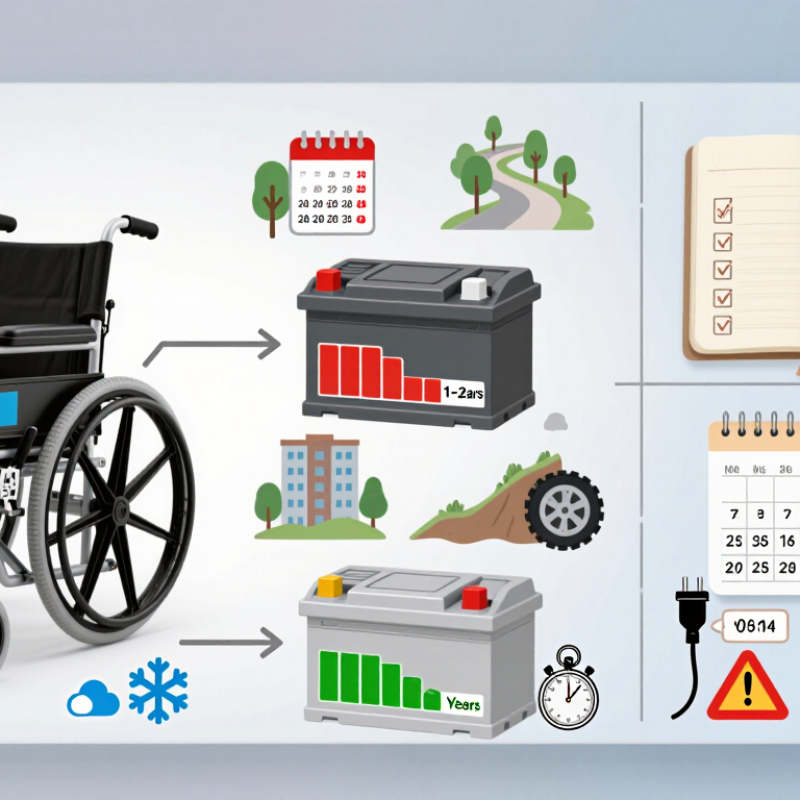
SLA, AGM, gel, and lithium-ion batteries behave differently in electric wheelchairs. SLA batteries are usually affordable and widely available, but they are heavy. With regular charging, they often last 12 to 24 months. AGM batteries use a tighter internal design, so they resist vibration better. Their service life can reach two years, though frequent deep discharges shorten it.
Gel batteries provide steady power and tolerate repeated cycling reasonably well. They may last two to four years when charged with the correct gel setting. An unsuitable charger can damage them quietly. Lithium-ion batteries are lighter and usually deliver more usable energy per charge. Many can serve for three to five years, or roughly 500 to 1,000 cycles. They also need compatible charging electronics and careful temperature control. They are not automatically the best choice for every user.
Real life is messier. A wheelchair used outdoors on hills may drain batteries faster than one used indoors. Cold mornings can reduce driving range, while leaving a chair unused for months may cause permanent capacity loss. In practical maintenance checks, a battery showing full voltage can still fail under load. That detail is often missed. Check charging time, range, terminal condition, and unusual heat together. Keep terminals clean, avoid mixing old and new batteries, and follow the wheelchair’s charging instructions. A small range drop may be normal, but a sudden drop deserves testing.
Top Electric Wheelchair Batteries: How Long Do They Last?
The chart compares typical rated cycle life for common electric wheelchair battery types. One full cycle represents using the equivalent of 100% of the battery's usable capacity. Actual service life depends on charging habits, depth of discharge, temperature, storage, battery quality, and daily usage. SLA batteries generally have the shortest cycle life, while lithium-ion batteries typically last the longest.
Key Factors That Reduce Battery Life: Weight, Terrain, Temperature, and Charging Habits
Top Electric Wheelchair Batteries: How Long Do They Last?
Key Factors That Reduce Battery Life: Weight, Terrain, Temperature, and Charging Habits
Most electric wheelchair batteries last between one and three years. Actual service life depends heavily on daily use, battery type, and maintenance. A heavier passenger or extra equipment makes the motor work harder. This increases current demand and can shorten each trip. A wheelchair carrying excessive weight may also experience faster battery wear over time.
Terrain changes performance noticeably. Smooth indoor floors require less energy than grass, gravel, ramps, or steep hills. Frequent starts and stops drain power faster than steady movement. Cold weather matters. Low temperatures temporarily reduce battery capacity, while long-term exposure to heat can damage internal components. Store batteries in a dry, moderate environment whenever possible.
Charging habits deserve careful attention. Recharge the battery after regular use, rather than repeatedly waiting until it is nearly empty. Use the correct charger and keep the charging connection clean. Do not leave a damaged battery unattended while charging. For long-term storage, check the battery periodically because complete discharge can cause permanent capacity loss.
A mileage estimate can mislead. Two users may own identical wheelchairs but receive very different results. A battery that once travelled twelve miles may later manage only eight under heavier loads or colder conditions. That decline is not always sudden. Testing voltage, charge time, and real-world range provides better evidence than relying on age alone. My own assessment would still remain cautious, because driving habits are difficult to measure precisely.
Top Electric Wheelchair Batteries: How Long Do They Last? — Key Factors That Reduce Battery Life
| Battery Type |
Typical Service Life |
Approximate Cycle Life |
Typical Range per Charge |
Important Considerations |
Sealed lead-acid
AGM or gel |
Approximately 1–2 years with regular use |
About 300–500 cycles |
Approximately 8–15 miles (13–24 km) |
Lower purchase cost, but service life drops when the battery is deeply discharged, stored empty, or exposed to high temperatures. |
| Lithium-ion |
Approximately 3–5 years with regular use |
About 800–2,000 cycles, depending on cell design and use |
Approximately 10–20 miles (16–32 km) |
Typically lighter and more energy-dense; it requires the correct charger and protection system. |
| Factor |
Typical Conditions |
How It Reduces Battery Life |
Estimated Practical Impact |
Ways to Reduce the Effect |
| User and cargo weight |
A load near or above the wheelchair’s rated capacity |
The motor draws more current, especially during acceleration and uphill travel. |
A 10% increase in total load can reduce range by roughly 3–8%, depending on speed and terrain. |
Stay within the rated capacity, remove unnecessary cargo, and avoid frequent hard acceleration. |
| Terrain and slopes |
Hills, ramps, grass, gravel, sand, and uneven surfaces |
Rolling resistance and climbing force increase motor current and battery heat. |
Frequent hills or soft ground may reduce range by approximately 15–40% compared with smooth, level pavement. |
Use firm routes where possible, maintain recommended tire pressure, and avoid unnecessary steep slopes. |
| Temperature |
Cold conditions below 10°C (50°F) or heat above 30°C (86°F) |
Cold temporarily reduces available capacity; sustained heat accelerates chemical aging. |
Cold-weather range can temporarily fall by about 10–25%; repeated heat exposure can permanently shorten service life. |
Store batteries in a dry, moderate environment and allow a cold battery to warm before charging. |
| Charging habits |
Repeated deep discharge, incomplete charging, or use of an incompatible charger |
Deep discharge and incorrect charging can cause capacity loss, sulfation in lead-acid batteries, or protection shutdowns in lithium-ion batteries. |
Poor charging practices can reduce usable capacity noticeably within months rather than years. |
Use the specified charger, recharge after use, and avoid routinely running the battery completely flat. |
| Storage duration |
Wheelchair unused for several weeks or months |
Self-discharge and gradual voltage loss can damage a battery left unattended. |
Lead-acid batteries are especially vulnerable when stored in a discharged state. |
Follow the battery manufacturer’s storage instructions and check the charge periodically during long-term storage. |
| Tire pressure and maintenance |
Underinflated tires, dragging brakes, dirty connectors, or misaligned components |
Mechanical resistance makes the motor work harder and increases energy consumption. |
Poor maintenance can reduce range by approximately 5–15% and increase motor or battery stress. |
Check tires, brakes, connectors, and drive components according to the wheelchair’s maintenance schedule. |
Note: Service-life and range figures are general estimates for commonly used electric wheelchairs. Actual results vary with battery capacity, wheelchair design, user weight, speed, route conditions, maintenance, and charging practices. Replace a battery when its capacity, range, or voltage performance no longer meets the user’s needs.
How to Estimate Daily Range Using Battery Voltage, Amp-Hours, and Motor Demand
Top Electric Wheelchair Batteries: How Long Do They Last?
Daily range is not a fixed promise. Battery voltage shows system pressure, while amp-hours indicate stored charge. A 24-volt, 50 Ah battery stores roughly 1,200 watt-hours before losses. Use the formula: watt-hours = volts × amp-hours. A motor drawing 300 watts could theoretically run for four hours. Real travel is shorter. Controllers, hills, rider weight, tire pressure, and cold weather consume energy. This estimate is useful, but imperfect.
To estimate range, multiply operating hours by average speed. If the chair moves 4 miles per hour for 3 hours, projected range is 12 miles. However, motors rarely draw a constant load. A flat hallway may need 150 watts, while grass or a ramp can demand 500 watts. Measuring average current during a normal trip gives better evidence than relying on label figures. Multiply voltage by average amps, then compare that demand with usable watt-hours. Keep a 20 percent reserve. My first estimates were optimistic because I ignored frequent starts.
Tips: Record battery voltage before and after a familiar route. Note hills, temperature, passenger load, and tire condition. Repeat the test twice. If results vary widely, inspect charging habits and battery age with a qualified technician. A battery can show normal voltage yet lose capacity under load. That detail is easy to miss.
When to Replace a Battery: Capacity Below 80% and Noticeable Range Loss
An electric wheelchair battery may need replacement before it completely fails. A practical warning point is capacity below 80% of its original rating, especially when range has clearly declined. IEC 61960-3 recommends controlled capacity testing for rechargeable cells, but wheelchair performance also depends on weight, terrain, tire pressure, temperature, and charging habits. Real use is messier.
The ISO 7176-4 wheelchair range test uses standardized conditions, so its published distance is not a promise for daily travel. A chair that once completed 20 kilometers may manage only 15 or 16 kilometers after moderate ageing. That is meaningful loss. Cold mornings can make the drop feel worse. Steep ramps expose weak batteries quickly.
Battery performance
Battery University’s BU-808 review reports that many lithium-ion batteries reach roughly 80% capacity after about 500 to 1,000 full cycles, depending on chemistry, heat, and charging conditions. Lead-acid batteries age differently and may show voltage collapse under load before resting voltage appears abnormal. Do not judge health from one dashboard reading. Ask a qualified technician to perform a measured capacity or load test, then compare results with the battery’s rated ampere-hours. Keep records.
Replacement timing is not perfectly precise. I would replace the battery when testing confirms capacity below 80%, range loss interrupts essential trips, or voltage drops sharply during acceleration. Waiting for total failure can leave someone stranded. Yet replacing too early wastes money and materials. That balance deserves more attention.
Conclusion
How long does an electric wheelchair battery last? The answer depends on the battery type, usage, and maintenance routine. Sealed lead-acid (SLA), AGM, and gel batteries generally provide around 300–500 charge cycles, while lithium-ion batteries can often reach approximately 1,000–2,000 cycles. Actual performance may vary because rider weight, steep or uneven terrain, temperature, and charging habits all affect battery life. Frequent deep discharges, extreme temperatures, and incomplete charging can reduce overall capacity.
To estimate daily travel range, consider the battery’s voltage and amp-hour rating, then compare its stored energy with the motor’s power demand and driving conditions. A battery should usually be considered for replacement when its usable capacity falls below about 80% of its original level or when the wheelchair shows a noticeable loss of range, slower performance, or frequent need for recharging. Regular charging and avoiding unnecessary strain can help extend service life.
 Welcare Wheelchair
